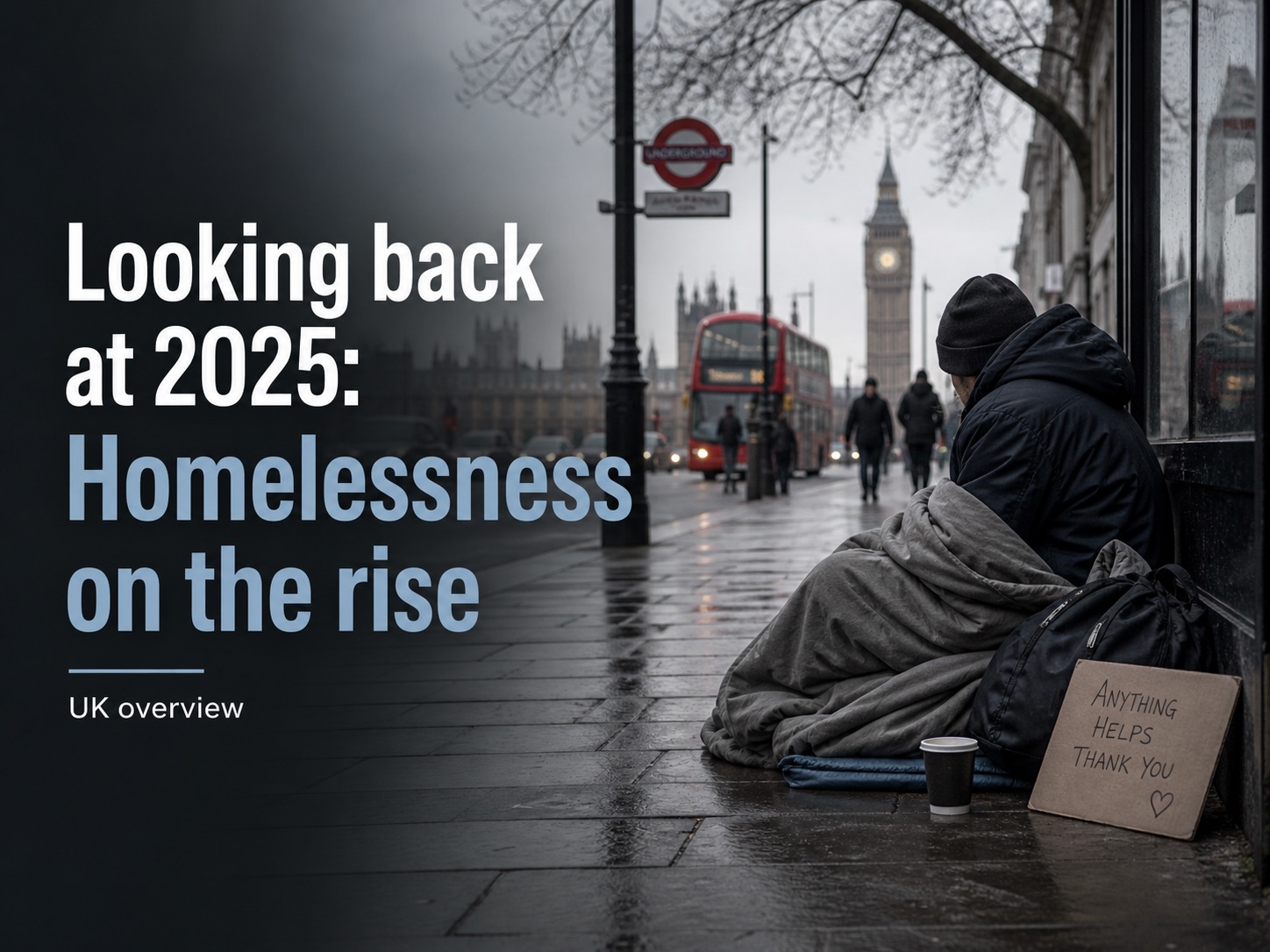
Looking Back at 2025: Homelessness on the Rise
When people talk about homelessness, rough sleeping is often the image that comes to mind first. It is the most visible, the most immediate, and the hardest to ignore.
But looking back at 2025, the story in England was bigger than that single image. The official figures published on GOV.UK pointed to a wider system under sustained pressure: more people sleeping rough, record numbers of households in temporary accommodation, and tens of thousands of children growing up without the security of a settled home.
Some quarterly measures moved up and down, as they often do. But the direction of travel on the bigger picture felt hard to miss. Homelessness did not become a smaller problem in 2025. In too many ways, it became a deeper one.
A sharp rise in rough sleeping
One of the starkest figures published during 2025 came in the government's Rough sleeping snapshot in England: autumn 2024, released in February.
That snapshot estimated that 4,667 people were sleeping rough on a single night in England, up 20% on the previous year. It was the third annual increase in a row. The rate also rose from 6.8 to 8.1 people per 100,000.
It is important to be accurate about what that means. This is not the total number of people who slept rough over a whole year. It is a single-night autumn snapshot. Even so, it remains one of the clearest official warning signs we have, and in 2025 that warning sign was flashing.
The same release showed that 45% of all people sleeping rough on that snapshot night were in London and the South East, underlining how concentrated the pressure remains in parts of the country where housing costs are especially punishing.
The less visible crisis kept growing too
Rough sleeping is only one part of homelessness, and often not the largest part. The quieter crisis is what happens when households do not end up on the street, but still cannot access stable, settled housing.
That was visible throughout 2025 in the temporary accommodation figures.
The government's Statutory homelessness in England: January to March 2025 release reported that 131,140 households were living in temporary accommodation on 31 March 2025. That was an 11.8% increase on the same point a year earlier, and the release described the number as a record level.
The impact on families was especially sobering. 83,150 households with children were in temporary accommodation, and within those households were 169,050 dependent children.
That is the sort of figure that should stop all of us for a moment. It is not just a housing number. It is a childhood number. It is a schooling number. It is a health and wellbeing number.
And for some families, this is not a short stopgap. The same government release noted that the most common length of time for households with children in temporary accommodation was 5+ years. That tells its own story about how stretched the system has become.
2025 showed that prevention is still under strain
Another lesson from the official data is that homelessness pressures are still being driven by familiar fault lines.
In January to March 2025, the end of a private rented assured shorthold tenancy was the single most common reason households were owed a prevention duty, accounting for 13,790 households, or 36.7% of prevention cases.
Within that, 6,640 households were threatened with homelessness because of a Section 21 notice.
For households already homeless and owed a relief duty, the most common reason was family or friends no longer willing or able to accommodate, affecting 13,470 households. Domestic abuse remained a major factor too, accounting for 7,110 households, or 15.5% of relief duty cases.
Taken together, those figures paint a picture that will feel familiar to anyone working in housing, supported accommodation, or frontline services. Private renting is still fragile for too many people. Informal arrangements with family and friends remain precarious. And when support systems break down, the consequences are often immediate.
There were a few signs of improvement - but not enough to change the overall picture
The 2025 data was not bad news in every single category.
For example, by 31 March 2025 the number of households with children in B&B temporary accommodation had fallen to 3,870, down 30.1% year on year. The number staying beyond the statutory six-week limit also fell.
That matters. Any reduction in unsuitable accommodation for families is welcome.
But it would be hard to argue that this changed the wider picture. When overall temporary accommodation is still at record levels, when rough sleeping has risen sharply, and when so many children are living without settled housing, the bigger trend still points in the wrong direction.
What the housing sector kept coming back to
One of the more useful things about reading sector commentary alongside the official data is that it helps explain what the numbers feel like on the ground.
Throughout 2025, housing association voices and wider housing-sector bodies kept returning to a few consistent themes.
The National Housing Federation has been clear that homelessness cannot be tackled by emergency responses alone. Its work on homelessness, rough sleeping, Housing First, and the Commitment to Refer all points to the same conclusion: lasting progress depends on early intervention, coordinated local partnerships, and support that continues after somebody is housed.
That same message comes through in commentary from Homes for Cathy, where housing associations have emphasised local collaboration, practical prevention work, and properly supported move-on routes rather than crisis management alone.
Put simply: a roof matters, but so does everything wrapped around it. Stable staffing. Trusted local partnerships. Mental health support. Tenancy sustainment. Clear routes into longer-term housing. Without those pieces, emergency accommodation can become a holding pattern rather than a turning point.
What this means for supported housing providers
For those of us working around supported housing and homelessness services, these are not distant policy questions.
When homelessness rises, the pressure lands somewhere very real: on scheme managers, concierge teams, support workers, local authority officers, outreach teams, and residents themselves.
Higher homelessness pressure often means fuller buildings, more complex referrals, longer stays, greater safeguarding demands, and more strain on staff trying to maintain calm, safe, well-run environments. It also means the quality and consistency of frontline staffing matters even more.
If someone has moved through rough sleeping, temporary accommodation, or repeated housing insecurity, the service they arrive at needs to feel predictable and safe from day one. That is not created by policy alone. It is created by people, systems, and day-to-day operational consistency.
A final thought looking into 2026
If 2025 taught us anything, it is that homelessness is not one issue with one solution. Rough sleeping may be the most visible expression of it, but the wider crisis includes temporary accommodation, housing insecurity, family breakdown, domestic abuse, and the long-term shortage of genuinely affordable homes.
The official figures published through 2025 showed that England is still carrying serious homelessness pressure. Some measures improved. Many did not. Too many people are still living without the stability that most of us would consider the bare minimum.
For 2026, the challenge should be clear: prevent homelessness earlier, reduce reliance on temporary accommodation, strengthen move-on pathways, and invest in the frontline services that help people sustain housing once they get it.
We should not allow record levels of temporary accommodation to start feeling normal. Behind every headline figure is a person, a family, or a child waiting for stability.
Sources and further reading
- Rough sleeping snapshot in England: autumn 2024 - GOV.UK
- Statutory homelessness in England: January to March 2025 - GOV.UK
- Statutory homelessness in England: October to December 2024 - GOV.UK
- Working together to end homelessness - National Housing Federation
- How Housing First can improve both individual and community health - National Housing Federation
- Local collaboration centric to tackling complexities of homelessness - Homes for Cathy